Shaker Cabinets Online: Colour Across Batches
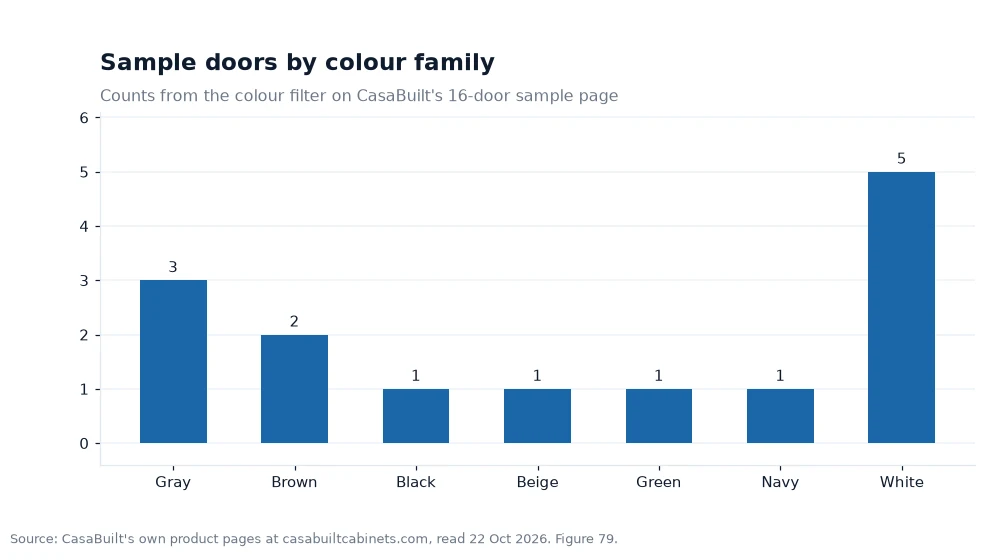
Paint is mixed in batches, and a batch is a moment in time: the same formula poured on a different day can land a shade apart, which is invisible on one door and obvious across a run of twelve. CasaBuilt's sample page stocks 16 doors across four profiles, and its color filter groups the range into White 5, Gray 3, Brown 2 and one each of Black, Beige, Green and Navy, while two premium doors sit outside the standard set. The sample set is the cheapest tool a buyer has for judging color before committing to a whole kitchen.
Key takeaways
- The sample range covers 16 doors: 8 Shaker, 3 Double Shaker, 3 Slim Shaker and 2 Frameless.
- Color families run White 5, Gray 3, Brown 2, then Black, Beige, Green and Navy at 1 each.
- Each sample is $9.99 against a $19.99 list price and is refundable with a cabinet purchase.
- Two premium samples are priced separately: Black Quarterline at $19.50 and Beach Impression at $22.00.
Why a batch can drift, and why it matters in a kitchen
Painted cabinetry is a coating process, and every coating process has variables: pigment dispersion, viscosity, spray distance, film thickness and curing temperature. A shop controls those variables tightly, and a small drift between batches is still normal in any painted product. The risk is not that the drift exists. The risk is that it appears mid-run, where two doors meet.
A single door in isolation hides a shade difference completely. Two doors side by side under the same light do not, especially in a white or pale gray finish where the eye is tuned to tiny shifts. That is why the color question is really a sequencing question: order the kitchen as one batch and the doors were mixed from the same pot.
There is a second variable that buyers confuse with batch drift, and it is lighting. A north-facing kitchen sees a cooler, bluer light than a south-facing one, and the same white door can read warm in one room and gray in the other. Seven layers of paint with a UV protective finish slow the shift over time, but they cannot change the light in the room on the day you look.
What the sample range contains
The sample program is small enough to describe precisely, which is useful, because a sample set that mirrors the catalog tells a buyer what the company expects to sell. The 16 doors break down by profile and by color, and the two breakdowns do not total the same number, which is worth understanding before ordering.
| Sample profile | Published count | What it tests |
|---|---|---|
| Shaker | 8 | Standard five-piece door with a flat recessed panel |
| Double Shaker | 3 | Two-panel door with an additional center rail |
| Slim Shaker | 3 | Narrower frame, more panel visible |
| Frameless | 2 | Door meeting the box edge with no face frame |
Eight Shaker doors against three Slim Shaker doors is a ratio of roughly 2.7 to 1, and it matches the catalog, where the standard Shaker profile carries the widest style list. The two Frameless samples are the smallest group, which fits a collection that holds two items. A buyer who wants a slim profile or a frameless box should ask for those samples specifically rather than assume the standard door represents the line.
The color split is the other half of the picture. White at 5 is the largest family by a clear margin, then Gray at 3, Brown at 2, and one each of Black, Beige, Green and Navy. Read together, the two breakdowns describe a range built around white and gray, with the saturated colors available but not stocked deeply.
How to check a sample properly
A sample checked indoors under a phone flashlight tells you almost nothing. Take the door to the room, hold it against the wall where the cabinet will hang, and look at it three times: mid-morning, late afternoon and after dark with the room lights on. The differences between those three views are larger than the differences between most adjacent colors in the range.
Then compare it with what is already in the room. A white door next to a warm oak floor picks up a yellow cast that disappears next to a gray counter. This is not a defect in the door; it is how color works, and it is why the sample should travel to the room instead of the buyer judging it in a warehouse.
Finish texture matters as much as hue. A painted flat panel shows the surface rather than hiding it, so a door with a level, well-built finish looks smoother at a low angle than one with thin edges. Tilt the sample until the light rakes across it. That angle is the one that reveals a dry patch or a sag in the coating.
Buyers comparing shaker cabinets online have an advantage that showroom buyers do not: they can order several doors at once and compare them side by side in their own kitchen. The door sample collection lists the full set with the color names, and the sample fee is refundable with a cabinet purchase.
Order once, not twice
The most reliable way to avoid a batch mismatch is to avoid a second order. That means finalizing the cabinet list before the first order ships, including the filler strips, the toe kick, the end panels and any extra door for a later appliance change. A single extra door ordered six months later is the classic mismatch, and it is a mismatch nobody notices until it is hanging next to its neighbors.
When a second order is unavoidable, order the door and keep it in its packaging until the rest of the run is installed, then compare it in place under the room light. If it reads differently, the conversation is about a replacement, not about repainting a kitchen.
There is a practical limit to how much a buyer can control here. Wood and paint both respond to humidity, and a door that has been in a dry warehouse for a month will look slightly different from one that has been in a steamy kitchen for a month. Give new doors a week in the room before judging them.
Worked example: reconciling the two sample counts
The chart gives the color tallies: Gray 3, Brown 2, Black 1, Beige 1, Green 1, Navy 1 and White 5. Add them in that order and the total is 3 + 2 + 1 + 1 + 1 + 1 + 5 = 14 doors. The profile table gives 8 Shaker + 3 Double Shaker + 3 Slim Shaker + 2 Frameless = 16 doors, and the published stock figure is 16.
So 16 - 14 = 2 doors are counted by profile but not by color family. The page also lists two premium samples priced separately, Black Quarterline at $19.50 and Beach Impression at $22.00, which accounts for the two missing entries. As a share of the set, the 14 color-filtered doors are 14 / 16 = 87.5 percent, and the White family alone is 5 / 14 = 35.7 percent of those 14.
Price the whole standard set: 16 doors at the $9.99 sample price is 16 x $9.99 = $159.84, against a list value of 16 x $19.99 = $319.84, a difference of $160.00. Add the two premium samples and the total becomes $159.84 + $19.50 + $22.00 = $201.34. For a kitchen whose cabinets run into the thousands, that is the cheapest insurance in the project.
Frequently asked questions
Will a second cabinet order match the first one exactly?
Not reliably, because paint is mixed per batch and a later batch can land a shade away. The practical safeguard is to order the whole kitchen at once, including spare doors and panels, and to keep any later door in the room for a week before judging it under the actual lighting.
How many samples should I order?
Two or three in the colors you are seriously considering, plus one in a profile you have not seen in person. The published range has 16 doors, and a sample is $9.99 against a $19.99 list price, refundable with a cabinet purchase.
Does the sample cost come off the cabinet order?
The published terms describe the sample fee as refundable with a cabinet purchase. Keep the order confirmation and ask support to apply the credit when the cabinet order is placed, rather than assuming it is deducted automatically.
Judge the color in the room, then order the run
Order samples in the two or three finishes on your shortlist and live with them for a week. Look at them at the height they will hang, next to the floor and the counter sample, in the light your kitchen actually gets. Then place one order for every door the kitchen will ever need.
Color is the cheapest part of a kitchen to test and the most expensive part to get wrong. A $9.99 door is a small price for avoiding a second batch.
Figures quoted here come from the manufacturer's own website, read 22 Oct 2026[1].