Container Mining vs Purpose-Built Buildings
The container-versus-building argument is usually framed as capex against speed, and the number that decides it is missing from both columns: thermal derating. At 500 kW of 20 J/TH hardware, a site produces 25 PH/s, about $949.82 of gross mining income a day, and a 5% summer derating removes roughly $9.59 a day — about $288 a month, or $3,456 a year.

Key takeaways
- Compare sites on contribution per day, not on capacity: 500 kW at 20 J/TH gives 25 PH/s, $949.82 of gross income, $720.00 of power at $0.06/kWh and about $191.83 of contribution.
- Derating is the hidden line item. Five percent of lost hashrate is about $9.59 a day of contribution at that site — roughly $863 across a 90-day hot season.
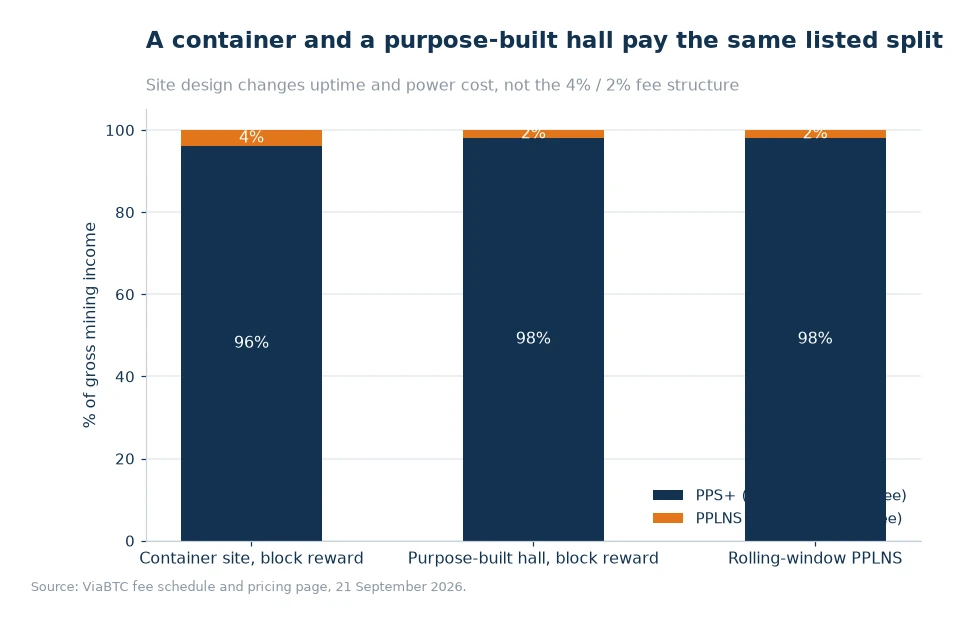
- The listed pool fee structure — 4% on the PPS-settled block reward, 2% on the PPLNS-distributed components — is identical in a container and in a hall.
- Ask for a year of per-month hashrate records before signing: the design question is really "what does this site produce in its hottest week?"
Definitions first
A container site is a modular unit: a steel enclosure with racks, power distribution and cooling built in, dropped on a pad and connected to a feed. A purpose-built building is a permanent structure designed around airflow, service corridors and electrical rooms. Both ultimately do the same job — keep ASICs inside their thermal envelope while power arrives reliably — but they fail in different places.
What matters for mining economics is not the enclosure, it is the set of constraints the enclosure imposes: how many kilowatts fit per square metre, how much air the cooling can move at 40°C ambient, how long a fan or power supply swap takes, and how tightly the site's power contract matches its cooling capacity. Two sites with the same nameplate capacity can differ by double digits in delivered hashrate in July.
The trade-off nobody prices
Containers are quick to deploy and quick to relocate, which has value when hardware is changing fast or a power contract is short. Purpose-built halls cost more upfront and are slower to build, which buys airflow designed for the load rather than fitted into a box. Neither is inherently cheaper; they simply load the cost into different line items.
The line item that gets left out of the comparison is derating, and it is easy to price once you have the numbers. Take a 500 kW site running 20 J/TH machines: total hashrate is 500,000 W ÷ 20 J/TH, or 25 PH/s. Gross income is 25,000 × $0.037993, which is $949.82 a day, and net of the listed 4% fee about $911.83. Power is 500 kW × 24 hours = 12,000 kWh a day, or $720.00 at $0.06/kWh, leaving $191.83 of contribution.
Now assume the site runs 5% below nameplate hashrate for three months of hot weather because chips throttle. The income side falls by 5% of the net figure — about $45.59 a day — and power falls too, by roughly $36.00 a day, because throttled chips draw less. Contribution drops by 5% of $191.83, which is $9.59 a day, and that is the honest cost of derating: a percentage of margin, not of revenue. Sustained across a 90-day hot season, that is roughly $863 for the year.
| Scenario | Delivered hashrate | Net income per day | Power cost per day | Contribution per day |
|---|---|---|---|---|
| Nameplate, no derating | 25 PH/s | $911.83 | $720.00 | $191.83 |
| 2% summer derating | 24.5 PH/s | $893.59 | $705.60 | $187.99 |
| 5% summer derating | 23.75 PH/s | $866.24 | $684.00 | $182.24 |
| 10% summer derating | 22.5 PH/s | $820.65 | $648.00 | $172.65 |
The table gives the decision rule directly: multiply the seasonal derating figure by the years you expect to run the hardware, and compare the result with the capex or power-rate premium of the better-cooled option. A 5% derating over a 90-day hot season costs about $863 at this site, so a purpose-built hall carrying less than that per year in extra cost is the cheaper choice — and a container with genuinely lower derating than a poorly designed hall wins in the opposite case.
Example with two setups
Setup A — 500 kW container pad. Two containers, 25 PH/s at nameplate, 5% average summer derating, and a service constraint: the containers are stacked, so a fan swap on an upper unit needs a ladder and daylight. Assume derating is real for 90 days of the year and zero for the rest. Derating cost for the season is about $863, and every repair day costs unplanned hashrate at the moment it is least convenient.
Setup B — 500 kW purpose-built hall. Same 25 PH/s at nameplate, 1% derating, and front-of-rack access with a service aisle. Seasonal derating cost is about $173, so the design buys back roughly $691 a year compared with Setup A. Factor in repair speed — a three-day fan swap on four units at 250 TH/s each costs about 3 × 4 × $9.12 of net income if the machines are fully down, roughly $109 — and the hall's advantage compounds every time something fails.
Neither setup changes the pool side of the ledger. Reported hashrate comes from the same workers in both cases, and a pool dashboard showing per-worker hashrate is the fastest way to see derating as it happens: delivered hashrate falls while every unit still reports as online, which is precisely the signal a site-level availability figure will never show you.
Practical next steps
- Ask for monthly hashrate history. Twelve months of delivered hashrate from a comparable tenant is worth more than any specification sheet, and it makes derating a known number rather than an assumption.
- Price derating per season, not per day. Five percent at 500 kW and 20 J/TH is about $863 across a 90-day hot season; a 10% derating roughly doubles that to $1,726. Put the figure in the same column as the site's power rate.
- Model repair access. Stacked units and sealed containers cost real income when fans fail in a heat wave. Count the expected failure rate per year and multiply by days of exposure.
- Keep the hardware efficiency in view. A 30 J/TH rig at the same site consumes $43.20 a day per PH/s against $36.47 of net income, so site design cannot rescue hardware that cannot cover its own power.
- Confirm the exit path. If relocating the fleet later is part of the plan, containers and farm-managed hosting both keep workers visible in a pool account, which makes a move a re-point rather than a rebuild.
- Check what the model can earn today. Before committing capex to a site, confirm the machines you plan to install still clear their power bill at current difficulty with a live miner profitability ranking.
Whatever the enclosure, hosting through a farm entry point keeps the operational view honest: ViaBTC Mining Farms puts hosted hashrate under the same account structure as your own machines, which means the delivered-hashrate series you use to judge a site is the pool's data rather than the site's report.[1]
Frequently asked questions
How often should a miner check pool statistics?
Weekly is enough for cash flow, daily if you are reconciling worker uptime or chasing a hashrate fault.
Does the payout method change my average income?
It changes the variance and the fee, not the underlying expected value: your share of network hashrate still sets the ceiling.
Which site design is cheaper overall?
Whichever has the lower total of power cost plus derating cost plus repair exposure, per kilowatt installed. Containers win on speed and relocatability, purpose-built halls win when summer derating is materially lower.
How do I see derating from outside the site?
Per-worker hashrate in the pool account. Units stay "online" while throttling, so delivered hashrate is the only series that captures it, and comparing it with the site's own availability figure is the whole audit.
Choose on delivered hashrate, not on nameplate
Write down the site's power rate, its derating record and its repair access, then compute contribution per day for the hardware you intend to install. Anything that cannot survive that arithmetic at 30 J/TH will not be saved by better cooling, and anything that can will be protected by it. Track delivered hashrate weekly from your own pool account, and revisit the comparison every time difficulty moves — the margin a good design protects is the same margin a fee change can take away.
Data and sources: ViaBTC fee and hosting documentation[1]. Network difficulty (132.76 T), network hashrate (1,003 EH/s) and the BTC price of $84,692 come from public chain data and market feeds read on 21 September 2026. Derating percentages are illustrative scenarios, not measured site data; all income, power and contribution figures are own calculations from those inputs.